Originally published on aspectsofhistory.com 9/8/26
‘The worst traitor there ever was’.
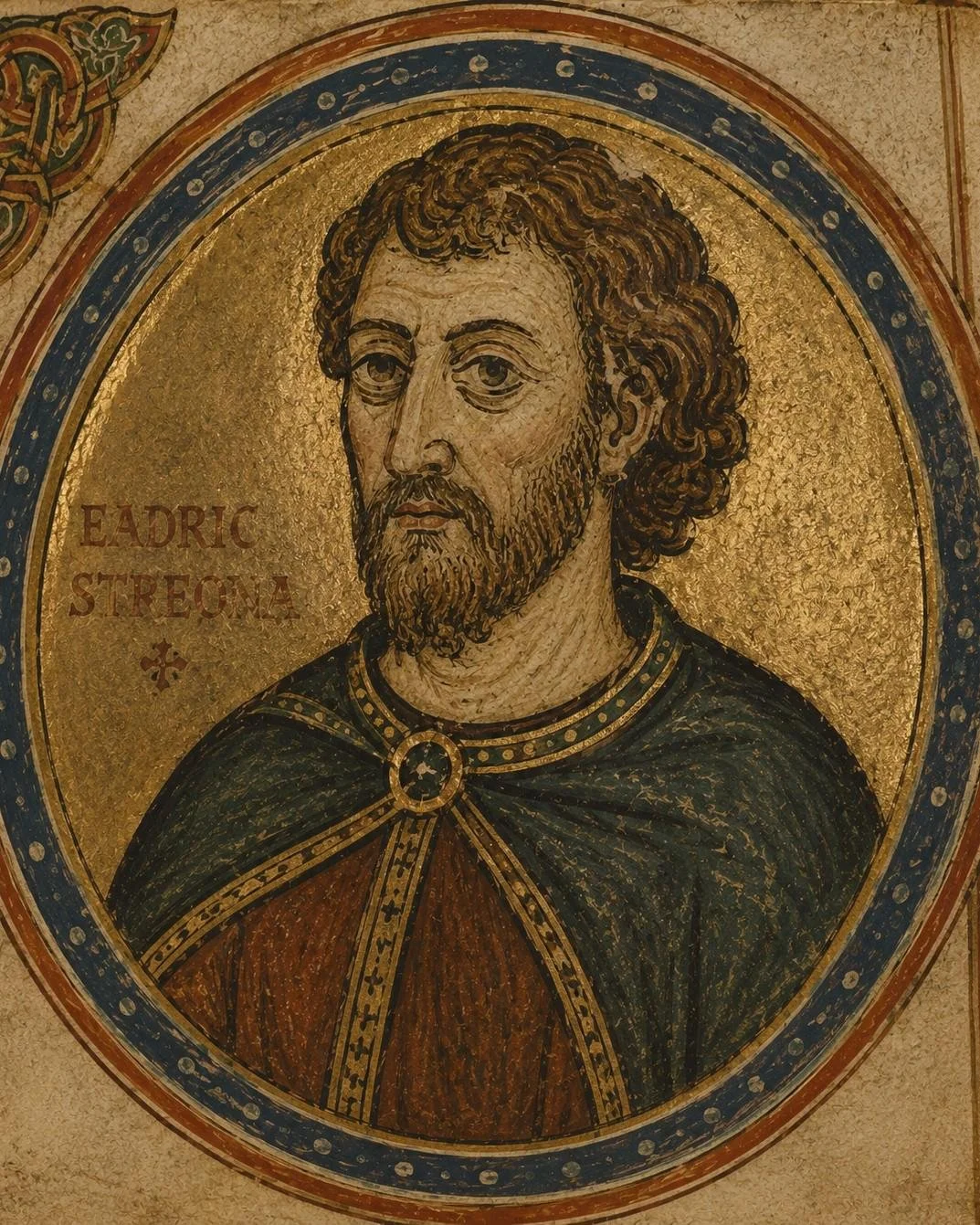
Writing in the 12th Century, this is how the chronicler Henry of Huntingdon describes Eadric Streona. John of Worcester described him as ‘crafty and treacherous’. William of Malmesbury called him ‘the dregs of mankind and a disgrace to his countrymen, a criminal debauchee and a cunning rascal’. His name, ‘Streona’, is a nickname meaning ‘the grasper’ or ‘the acquisitor’ and tells us much about this man’s character and motivations. But who was he?
Eadric Streona was an English nobleman who rose to power during the reign of King Aethelred the Unready (reigned 978 to 1016). Aethelred’s epithet, ‘the Unready’, derives from the old English word ‘Unraed’ which means ‘ill-counselled’ or ‘evil-counselled’. When looking for the evil counsellors who gave Aethelred his name, you really need look no further than Eadric.
Eadric’s origins are obscure. He did not come from a powerful noble family. His father, a thegn (local lord) probably from Shropshire or Herefordshire, seems to have attended King Aethelred’s court but does not appear to have held any significant positions of power. Eadric himself seems to have started attending the court in the 990s and by 1002 was witnessing charters which suggests that he was, by this time, a man of some significance.
He was certainly not a man to let others stand in his way. In 1006 he invited a regional rival, Ealdorman Aelfhelm, to a feast in Shrewsbury. After several days of partying together as great friends, Eadric invited Aelfhelm to go hunting with him in the woods. In the woods, awaiting Aelfhelm, was a local butcher by the name of Godwine Porthund. Godwine, whose surname translates as ‘town dog’, had been ‘dazzled long before with great gifts’, according to John of Worcester, and murdered Aelfhelm on Eadric’s orders.
The murder enhanced Eadric’s local power and seems to have had the tacit approval (if not active involvement) of King Aethelred who subsequently went on to blind Aelfhelm’s two sons.
It is not clear why Aethelred seems to have been so much in Eadric’s thrall. Some historians have described Eadric as an ‘enforcer’, and it may simply be that Eadric was willing to do Aethelred’s darkest bidding and so showed the king his value in that way. William of Malmesbury said that Eadric was ‘ready of wit’ and ‘smooth of speech’ so perhaps he was in possession of a dark charisma that Aethelred simply could not resist.
His place at Aethelred’s court was cemented shortly after the murder when he married Aethelred’s daughter, probably in 1007. This same year he was made Ealdorman of Mercia and so became one of the most powerful men in the land.
In his role of Ealdorman, Eadric was now a key advisor to Aethelred. When Thorkell the Tall, leader of the legendary Jomsvikings, invaded in 1009 Eadric was instrumental in convincing Aethelred to avoid battle, pay a huge Danegeld to Thorkell, and then employ the Viking as a mercenary. The constant attempt to pay off the Viking invaders, rather than fight them, is one of the key behaviours for which Aethelred has been criticised ever since and appears to be a policy encouraged by Eadric.
Eadric stayed within Aethelred’s inner circle in the following years. At the end of 1013, Sweyn Forkbeard landed in England and conquered the country having encountered little resistance. Aethelred fled to the Isle of Wight. It is probable that Eadric accompanied Aethelred’s wife, Emma, into exile in Normandy.
Sweyn did not stay England’s king for long. He died just five weeks after taking power. Whilst some in England proclaimed Sweyn’s son, Cnut, to be the new king, other members of the nobility invited Aethelred back and so precipitated the chaotic power struggle during which Eadric would show his true colours.
In 1015, Eadric was up to his old murderous tricks again. Two noble bothers, Sigefreth and Morcar, attended a royal council in Oxford. According to the Anglo-Saxon chronicle, Eadric ‘lured them into his chamber’ where he murdered them, probably at the request of Aethelred, and then seized their lands.
Later that year, Cnut returned to claim the crown that he believed to be rightfully his. King Aethelred was now sick with the illness from which he would ultimately die in 1016. Eadric gathered an army, ostensibly to fight Cnut, although it is believed that Eadric planned to defect to the Danish king. His plan was thwarted when his army was joined by that of the king’s son, known to history as Edmund Ironside. Instead of joining Cnut at that point, Eadric delayed, waiting instead for his army to separate from Edmund’s before taking forty ships from the royal fleet and sailing to join the Vikings.
Eadric stayed in Cnut’s service and helped him to ravage the lands of Warwickshire until Edmund Ironside managed to drive Cnut and the Danes away in a series of battles. Now Eadric defected from Cnut, back to the English.
The final reckoning between Cnut and Edmund was the Battle of Assundun in the autumn of 1016. Eadric went into the battle at Edmund’s side but, of course, he then withdrew his forces and defected back to Cnut, precipitating the defeat of the English. The country was briefly split in two, the north ruled by Cnut, the south by Edmund, but Edmund died a few weeks later, possibly from battle wounds, and Cnut took control of the whole county.
Eadric held onto his position as Ealdorman of Mercia under Cnut and, in 1017, went to Cnut to ask for a reward for all the conniving that had helped bring him to the throne. Cnut, disgusted by Eadric’s repeated treachery, told one of his warriors to ‘pay this man what he is owed’. The warrior stepped forward and promptly beheaded Eadric. Cnut is also supposed to have said to Eadric, ‘I will place you higher than all the lords of England’. He kept his promise by putting Eadric’s head on the tallest pike on London Bridge.
Few people in English history have been more treacherous than Eadric. And few people’s treachery has been more consequential. Abandoning Edmund Ironside at Assandun led to the loss of England to the Danes and its absorption into a North Sea empire. Ultimately, this defeat led to the events of 1066 so, arguably, Eadric Streona’s treachery also played a part in the loss of England to the Normans fifty years later. Few other people in history can be said to have betrayed their country so thoroughly that it led to the conquest of their country twice over.