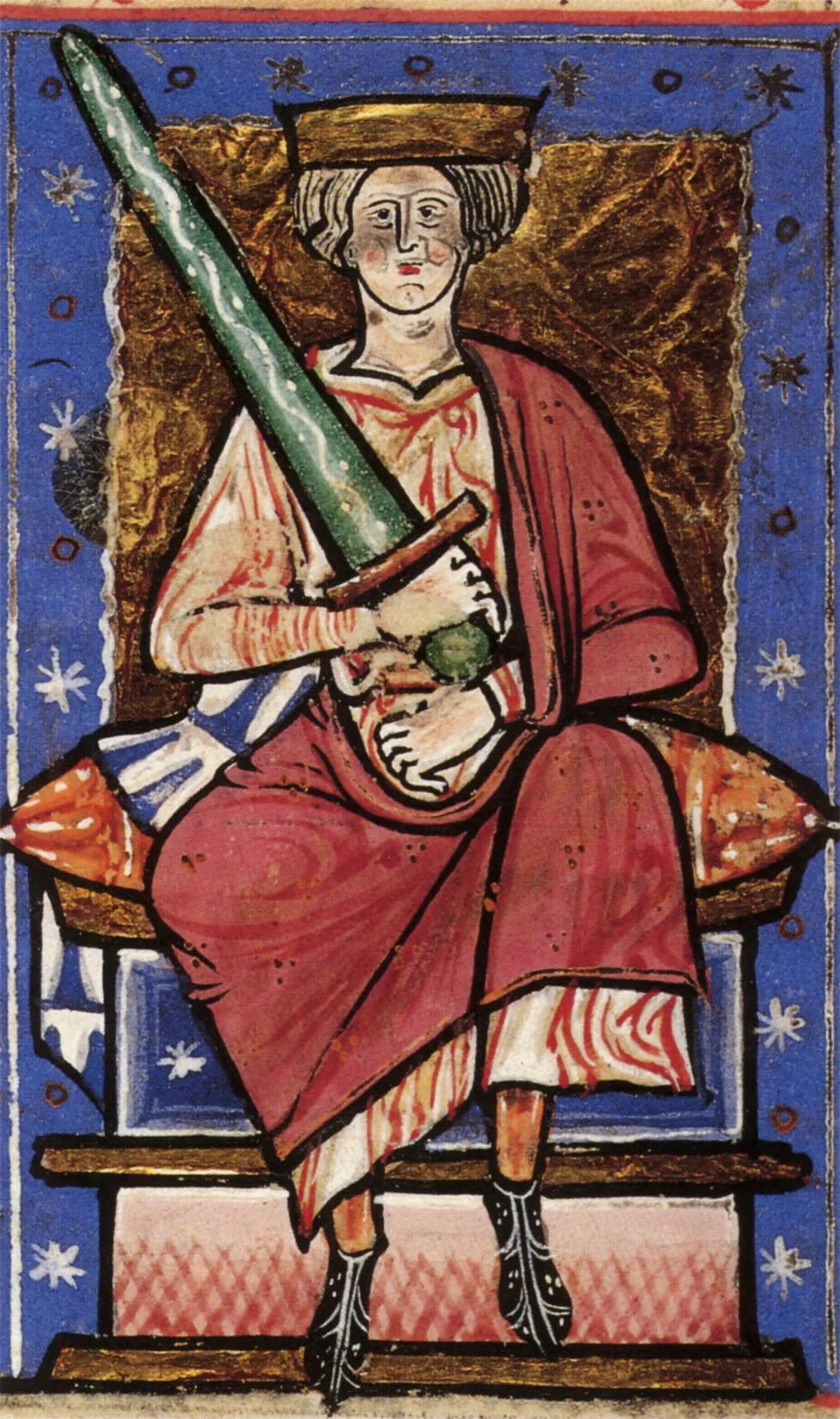
Originally published on aspectsofhistory.com
Aethelred II of England, known to history as Aethelred the Unready, is considered to be one of our most hopeless monarchs. For a thousand years he has had a reputation for failure that is perhaps only outdone by Bad King John. Yet Aethelred was the longest reigning Anglo-Saxon king, reigning for a total of thirty-eight years. Is it possible that a man who was so incompetent could survive for so long in a world where failure was usually dealt with at the end of a sword? Why did the English tolerate him for so long? And is his reputation deserved?
The Name
Aethelred’s epithet, ‘the unready’, does not mean what most people think. It does not derive from a lack of preparedness. The name Aethelred means ‘noble counsel’ or ‘noble advisor’. In Old English the word ‘unraed’ means ‘ill-advised’. The name Aethelred Unraed was in fact an Old English play on words meaning ‘Noble advisor the ill-advised’. It was unlikely that the name was ever used during his lifetime – the first evidence of its use is found in the 13th century, about 200 years after his death in 1016.
Over the years, the pun has gradually evolved into ‘the unready’ as the English language has changed.
Early Reign
Aethelred’s reign got off on the wrong foot. He was a younger son of Edgar the Peaceable who was king until his death in 975. As the name suggests, King Edgar had enjoyed a peaceful reign during which England had flourished. After his death, his son Edward became king. Edward reigned for just three years before he was murdered, probably on the orders of Aethelred’s beautiful but ambitious mother Aelfthryth.
It is unlikely that Aethelred had any hand in the planning of the murder as he was aged between 9 and 12 years old at the time, but it was considered an evil way for a man to take the throne, and one that might leave England accursed. Partly in reaction to the evil of this deed, a cult of sainthood sprang up around the murdered king, and he became known as ‘Edward the Martyr’.
When he took the throne in 978, Aethelred was still a child and so the early part of his reign was overseen by a counsel of advisors including his mother and other key noblemen and senior churchmen.
By the time Aethelred reached his majority, around the year 984, many of these advisors had died. Likely still a teenager, and now holding power for himself, Aethelred seems then to have gone a little wild. His mother disappears from the charters of this period, leading to the assumption that she was banished from court. Aethelred surrounded himself with new advisors and spent the next few years enriching himself by seizing land and properties from the church.
The Coming of the Vikings
By the year 991, England had enjoyed decades of peace and was one of the wealthiest countries in Europe – an enticing prospect for the Vikings. The Danish arrived that year, led by legendary warriors such as Olaf Trygvason and Sweyn Forkbeard. The Battle of Maldon was fought in Essex (and later immortalised in an Old English poem). The English were defeated, with Ealdorman Byrhtnoth killed, the first man of his rank to die in battle for a generation.
The defeat sent shockwaves through the country. The English were indeed ‘unready’ for the coming of the Danes. Decades of peace had led to a steady degradation of the country’s military capacity. Aethelred, advised by men such as Ealdorman Aelfric of Hampshire, decided to pay the Danes off by offering them an enormous ‘Danegeld’ of £10,000 in silver.
It is this strategy for which Aethelred has been so heavily criticised in the centuries since. In the words of Rudyard Kipling, ‘if once you have paid him the Danegeld, you never get rid of the Dane.’ But this was not a tactic just used by Aethelred; it had been used by kings before him, both in England and on the continent. Even Alfred the Great had occasionally resorted to paying Danegelds.
The problem, as Kipling identified, is that the Danegeld merely served to show just how wealthy the country was. If anything, it whetted the Danish appetite for plunder.
Of course, everybody realised at the time that the Danegeld was only a temporising measure. What was important was what you did with the time it bought – how you readied yourself for the next, inevitable battle.
In his defence, this is what Aethelred did. He gathered a fleet to take the Danes on and sent it out to find them with Ealdorman Aelfric in command. The problem was that Aelfric promptly betrayed the fleet to the Danes, even lending them his own ship, and the Danes escaped unscathed. This was not the last time that Aethelred would be betrayed.
The Era of the Danes.
Danish raids were to prove the defining feature of Aethelred’s reign. At first, he saw the Danish raids as divine punishment for his earlier transgressions. A charter in 993 explicitly references his need to make amends for his youthful follies and Aethelred now adopted a ‘penitential’ style of kingship, founding monasteries and compensating the institutions he had previously wronged in order to win back God’s favour.
But the Danes kept coming. And over and over again Aethelred responded to the threat by paying them off or, perhaps even more ill-advisedly, taking them on as his mercenaries. When, in 1001, a mercenary named Pallig joined in with Danish raids in Devon, Aethelred had had enough and he instigated one of the most notorious episodes of his reign; the St Brice’s Day Massacre.
The massacre, described by Aethelred himself as ‘a most just extermination’, is often presented as an order that all people of Danish origin within England should be killed. Given the long history of intermarriage between Danes and Anglo-Saxons, and the prior longstanding existence of the Danelaw in England, this order would have been unfeasible to execute. In fact, the archaeological evidence of mass graves, primarily from Oxford but also from a number of other sites around the country, suggests a much more targeted killing of fighting age males. Very likely, these were the mercenaries who had been plying their trade in England and were no longer trusted by Aethelred.
According to William of Malmesbury, writing in the 12th century, one of the victims was the sister of Sweyn Forkbeard, who was the wife of the aforementioned Pallig. It is possible that avenging the murder of his sister was one of the motivations for Sweyn Forkbeard’s repeated raids of England over the next decade.
Internal Strife
Clearly, appeasing God was not keeping the Danes at bay. Aethelred started to blame those around him, possibly under the influence of a rising man at court, Eadric Streona (which means Eadric ‘the grasper’). Eadric was a man of obscure background who connived and murdered his way to power, ably assisted by a psychotic butcher by the name of Porthund (‘town dog’).
Eadric murdered a number of noblemen, apparently with Aethelred’s tacit approval, and ultimately married Aethelred’s daughter, so joining himself to the royal family.
It is not clear why Aethelred was so much in Eadric’s thrall, but when looking for ‘ill-counsel’ he was even worse than Ealdorman Aelfric. Henry of Huntingdon, writing in the 12th century, described him as ‘the worst traitor there ever was’ because, in the chaotic final years of the reign, he defected back and forth from the English to the Vikings on multiple occasions. Eventually, once Cnut was king, he grew tired of this treachery and executed Eadric in 1017.
The End of the Reign
In 1013 Sweyn Forkbeard returned to England. He processed around the country and swathes of England submitted to him. London initially resisted but, seeing the writing on the wall, the Londoners finally also submitted to Sweyn. Aethelred sent his sons to Normandy and fled himself to the Isle of Wight.
Sweyn’s reign was short lived – he died just five weeks later. Whilst parts of England acclaimed his son Cnut as king, the English nobility recalled Aethelred and re-installed him on the throne, albeit after making him swear to them that he would be a better ruler than he had been before.
One of his first acts on his return was to ravage the old Kingdom of Lindsey (now Lincolnshire) as revenge for their defection to the Danes. It is one of the few military campaigns that he led himself. Overall, his unwillingness to lead his armies was another stain on his reputation. He actually tried to remedy this by issuing a penny with himself depicted on it as a warrior, although this small act of propaganda was unlikely to have changed many people’s opinion of him.
Aethelred died in 1016, still holding onto the crown. His death led to a power struggle between Cnut and Aethelred’s son, Edmund Ironside, that Cnut would ultimately win.
Did Aethelred Do Any Good?
The above is the usual narrative of Aethelred’s reign. It does not make for good reading. Yet, the fact remains that he stayed in power for nearly four decades – longer than any other Anglo-Saxon king – and seems not have faced any major internal challenges to his power. Not only this, but it is notable that the English re-instated him as king after Sweyn’s death when surely this would have been the ideal chance to make a change. He must therefore have been doing something right.
Ironically, the answer to this conundrum may lie with the enormous Danegelds for which Aethelred has been so criticised. The ability to rapidly gather such sums of money via taxation on a repeated basis speaks of a wealthy country and one that is governed by an effective and efficient bureaucracy. In fact, throughout his reign, Aethelred withdrew and re-issued coinage on many occasions using a complex and well-administered array of mints to do so, in order to ensure the smooth running of the economy and the sustained quality of English coinage.
Further evidence of good governance is found in the large number of charters that survive from his reign. These are largely concerned with property grants and land ownership and are another reflection of a country in which legal processes were being followed.
He appointed church reformers who appear to have been highly competent men, the majority of them holding onto their positions into the reign of Cnut. This church reform coincided with a period of cultural flourishing during which beautiful, illuminated manuscripts and works of literature were produced.
Perhaps it is for these reasons that the English kept him as their king. The historian Pauline Stafford has written ‘the first twenty-five years or more of Aethelred’s reign follows normal 10th-century patterns’. At the time, the English may have considered him to be a competent king who was understandably struggling to deal with the overwhelming onslaught of the Vikings. It appears they didn’t think any other Englishman of the age would do a better job.
Conclusion
Ultimately, Aethelred’s reign was a failure. It led to the absorption of England into the North Sea empire of King Cnut and sowed the seeds for the Norman Conquest in 1066. The historian Frank Stenton said that Aethelred ‘behaved like a man who is never sure of himself’ and the major failing of Aethelred seems to have been that he listened to the counsel of people such as Ealdorman Aelfric and Eadric Streona who subsequently betrayed him. So, perhaps it is fair after all to call him ‘Aethelred Unread’: Aethelred the Ill-advised.