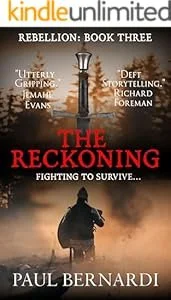
The Reckoning is the final installment of Paul Bernardi’s Rebellion trilogy. The three books are set in the years following the Norman Conquest and offer a fascinating insight into this turbulent period. These years are often overlooked, with the Norman Conquest usually presented as the result of a single battle – the Battle of Hastings – after which William of Normandy assumes control of England. The Rebellion trilogy allows Bernardi to explore the reality of post-conquest England, a country that was rocked by violent rebellion for years after 1066.
The story specifically focusses on the events in the north of England with the attempts of Earl Gospatric and Edgar Aetheling, last scion of the House of Wessex, to retake the country and put Edgar on the throne.
Bernardi’s protagonist is Oslac, lord of the village of Acum. Oslac is related to Earl Gospatric and is high enough up the social scale to be involved in the strategic planning of the uprisings, but low enough on the scale to allow Bernardi to paint a vivid and intimate picture of the life of the Anglo-Saxon peasantry. Oslac is an ageing and seasoned warrior who will not shirk his duty and not flinch from a fight, but he is also a man who keenly feels the loss and suffering of the men and women with whom he both lives at home and goes on campaign.
The Reckoning is set in the final months that lead to the Harrying of the North, William’s brutal response to the uprisings, that sees the north of England laid waste. On the one hand we are given the grand strategic activity of Gospatric and Edgar, on the other we get the denouement of Oslac’s personal enmity with the Norman knight Coutances and his murderous lieutenant, Rainbalt, who emerged as the villains of the second book in the trilogy. Like Oslac, Coutances is significant enough to matter in the plans of the Normans, but minor enough for the personal grudge between him and Oslac to feel realistic.
Bernardi is able to use this setting and his storyline to deliver gritty and gory action alongside domestic scenes that might be described as ‘cosy’. This juxtaposition between the violence of the battles and the loving, relatable home life of Oslac, allows you, as a reader, to consider what life was really life for the men of the ‘fyrd’ – those men of the peasantry who spent most of their life as farmers, tanners or blacksmiths but might suddenly be called upon to fight for their lord in battle. In this way, when Oslac loses a warrior in battle, Bernardi shows us the impact that this will have on a village that otherwise relies on that man to be bringing in the harvest or tending his sheep.
Given that the story ends at a point in English history that some historians describe as a genocide, don’t expect happy endings, but do expect rip-roaring action, huge swings in fortune, and a satisfying ending to a great trilogy.